Hyunwoo Gu
I am a Ph.D. candidate in Psychology (Neuroscience) at Stanford University, working with Justin Gardner. Previously, I completed my Master's degree in Brain and Cognitive Sciences at Seoul National University (SNU), where I worked with Sang-Hun Lee and Sukbin Lim. Before that, I completed three undergraduate majors in Psychology, Statistics, and Biological Sciences at SNU.
Research
How does the brain make sense of the world? My research goal is to decipher how our beliefs and goals shape perception and action. I combine experimental approach (psychophysics, eye-tracking, and neuroimaging) with computational approach (state-space models, probability theory, and deep neural networks).
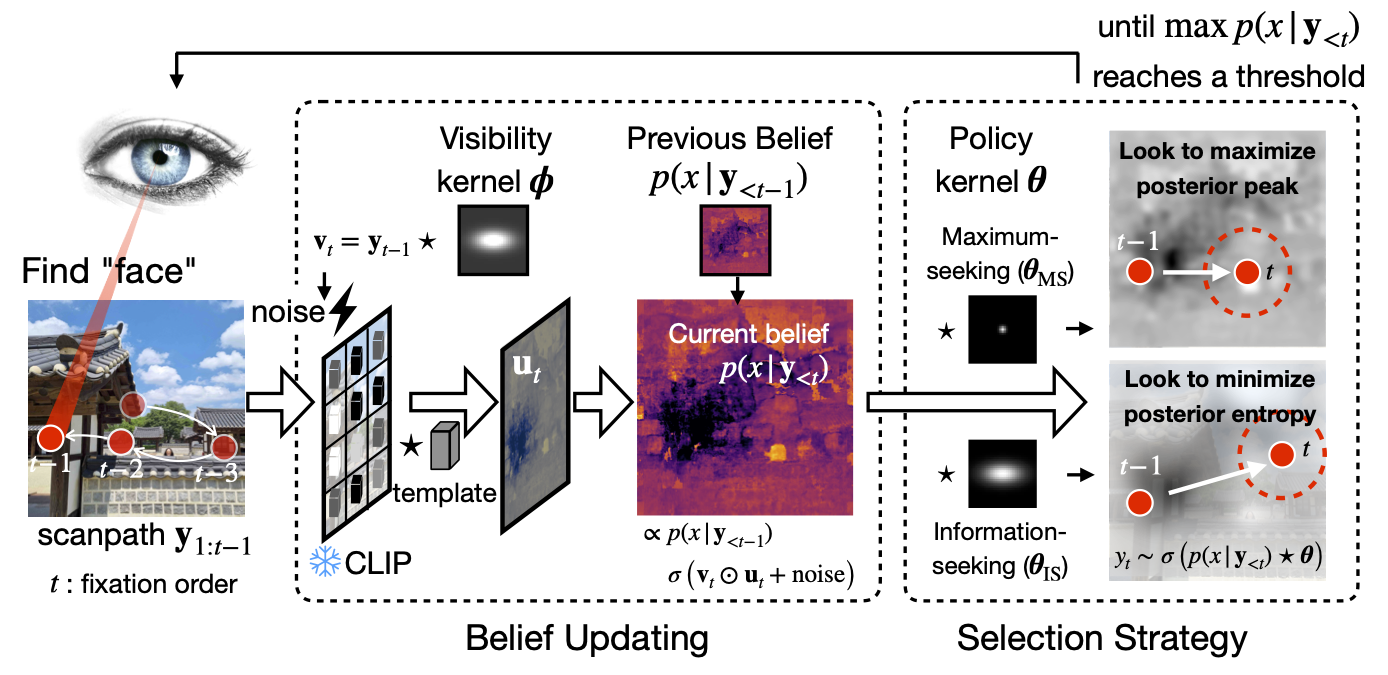 State-space model of human gaze selection strategies (Gu and Gardner, 2025, Cognitive Computational Neuroscience).
Predicting and controlling gaze selection strategies
Our visual world loses clarity beyond the center of the gaze. Thus, we move our eyes to bring whatever is relevant into our best view. My research investigates how natural gaze selection is guided by the interplay of bottom-up features and top-down goals. My Ph.D. work uses a dynamical-systems framework centered on prediction and control for (i) developing predictive models of gaze selection (Gu and Gardner, 2025), (ii) experimentally manipulating of gaze patterns through natural stimulus synthesis, and (iii) quantifying predictive saccades in everyday viewing contexts using data from wearable glasses.
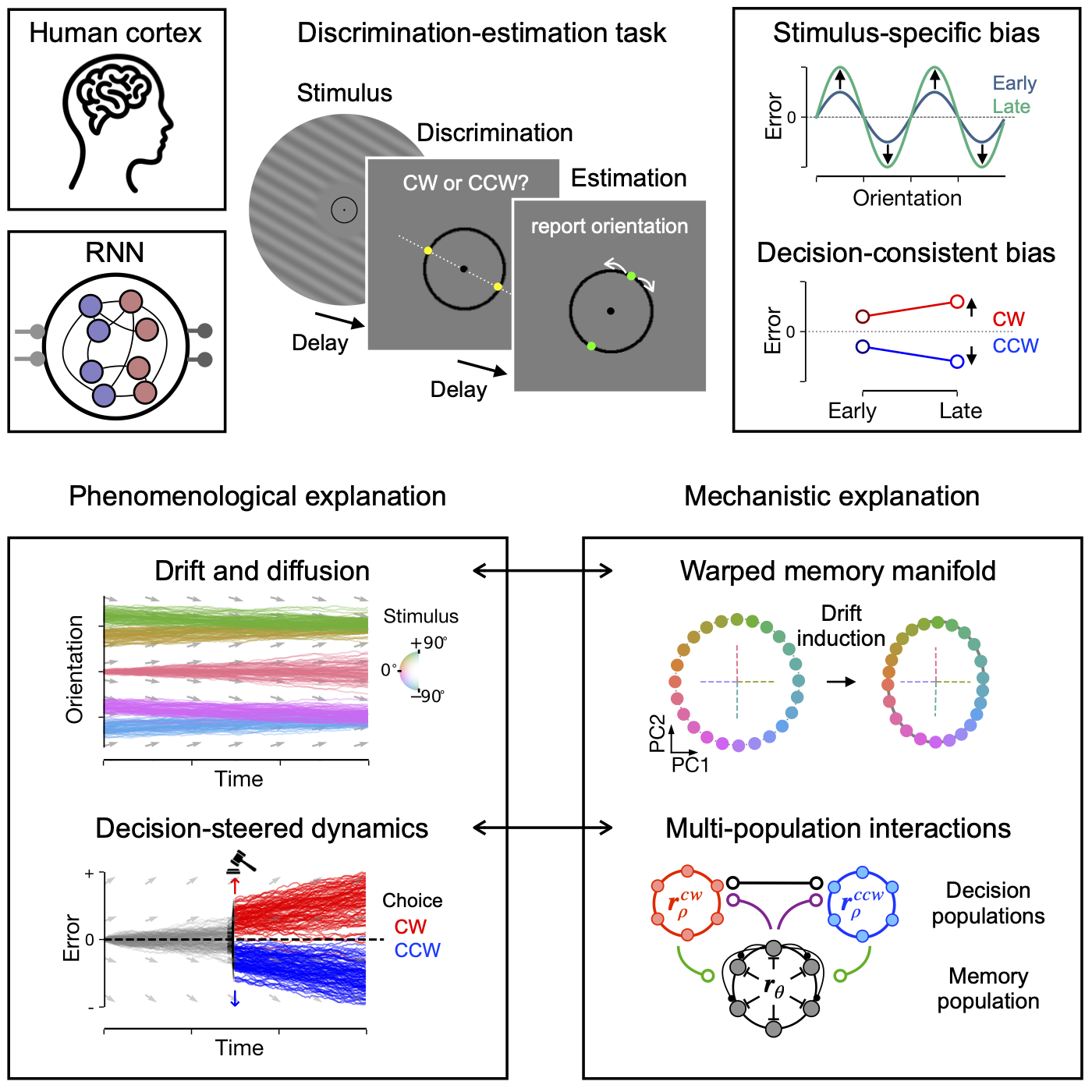 Intrinsic attractor dynamics underlying behavioral biases (Gu et al., 2025, Neuron).
Explaining the dynamics of perceptual biases
Perception is not a perfect mirror of the world. It is shaped by systematic biases that often reveal how our sensory systems efficiently encode the statistics of natural environments. In this line of work, I study how perception is influenced by these biases by parameterizing stimulus spaces and tracking behavioral and neural responses over time. We found that intrinsic attractor dynamics pull representations in the visual cortex (decoded from fMRI) toward stable states, and recurrent neural networks trained with task constraints reproduced similar behavioral biases (Gu et al., 2025; see also the Preview by Luo & Pascucci, 2025). We are following up with a study on the circuit mechanisms of decision-consistent biases. Recently, I have extended this framework to natural images, examining how human biases reflect the multidimensional statistical structure of natural scenes.